

Hand Planes
━━━━━━━━━━━━━━━━━━━━
Buck Bros. 7"
Block plane
A simple cleanup
━━━━━━━━━━━━━━━━━━━━
Sometimes the best additions to a workshop are the ones you weren't looking for.
Did you ever have one of those slow simmering collecting obsessions? You know the kind where you don't even realize you have this obsession until you look around one day and think to yourself, maybe a bit stunned...duuuude. I've had a few of these minor obsessions in my lifetime. When I was a kid I collected baseball cards, but then - what kid didn't back then? Then when I got older I went through a few other obsessions - collecting monster models, brewing beer, re-learning how to play the guitar, playing the harmonica, and on and on! That seems to be what's happening right now with my hand planes, I've somehow begun a nice little collection, and this post is about one of my several hand planes, A Buck Bros. block plane...

When a Collection Sneaks Up on You
I picked this little plane up at The Tool Box, one of those places that sells old tools that people donate to support senior citizens in the community. Most of the time when I go there I'm not looking for any tool in particular - just looking around to see what I might find. In this case, I picked up a couple nut drivers and, while at the checkout counter, I glanced to my right and saw a plane on a shelf. Out of curiosity, I checked it out and it was a block plane of a design that I didn't have!

Now, I already had a couple block planes...

But a plane for $8? How could I pass it up?

Not a Stanley After All
Not only did I not have this style of plane, I hadn't even seen this type! When I first started researching this plane I thought it was a Stanley #220. But the Stanley's all had a brass knob, and this one had a wood knob attached to the body with a screw. With a little more research I found that this plane is a Buck Bros. Block plane.
.jpg)
Why Every Shop Needs a Block Plane
A block plane is a small metal-bodied woodworking hand plane which typically has the blade bedded at a lower angle than other planes, with the bevel up. It is designed to cut end grain and do touchup or finish work. It is typically small enough to be used with one hand.

When I travel overseas to work and I have room for only one plane, I bring a block plane because I can easily alter it to do the job of many other tools, including a smoothing plane, miter plane, pencil sharpener, and even a toothing plane. - Christopher Schwartz in Popular Woodworking
The more I use hand planes, the more I understand why so many woodworkers keep a block plane within arm's reach. It's one of those rare tools that's almost always useful. Whether knocking the sharp corner off a board, fitting a drawer that sticks just a little, trimming end grain, or making a tiny adjustment that would be awkward with a power tool, a block plane seems to find its way into countless projects. Small enough to fit in one hand, yet capable of remarkably precise work, it's easy to see why they've remained a workshop staple for well over a century.
A Twenty-Minute Cleanup
One of the nice things about this plane is that it was in pretty good condition, so I took about a minute to take the plane apart and gave each part a good scrubbing.
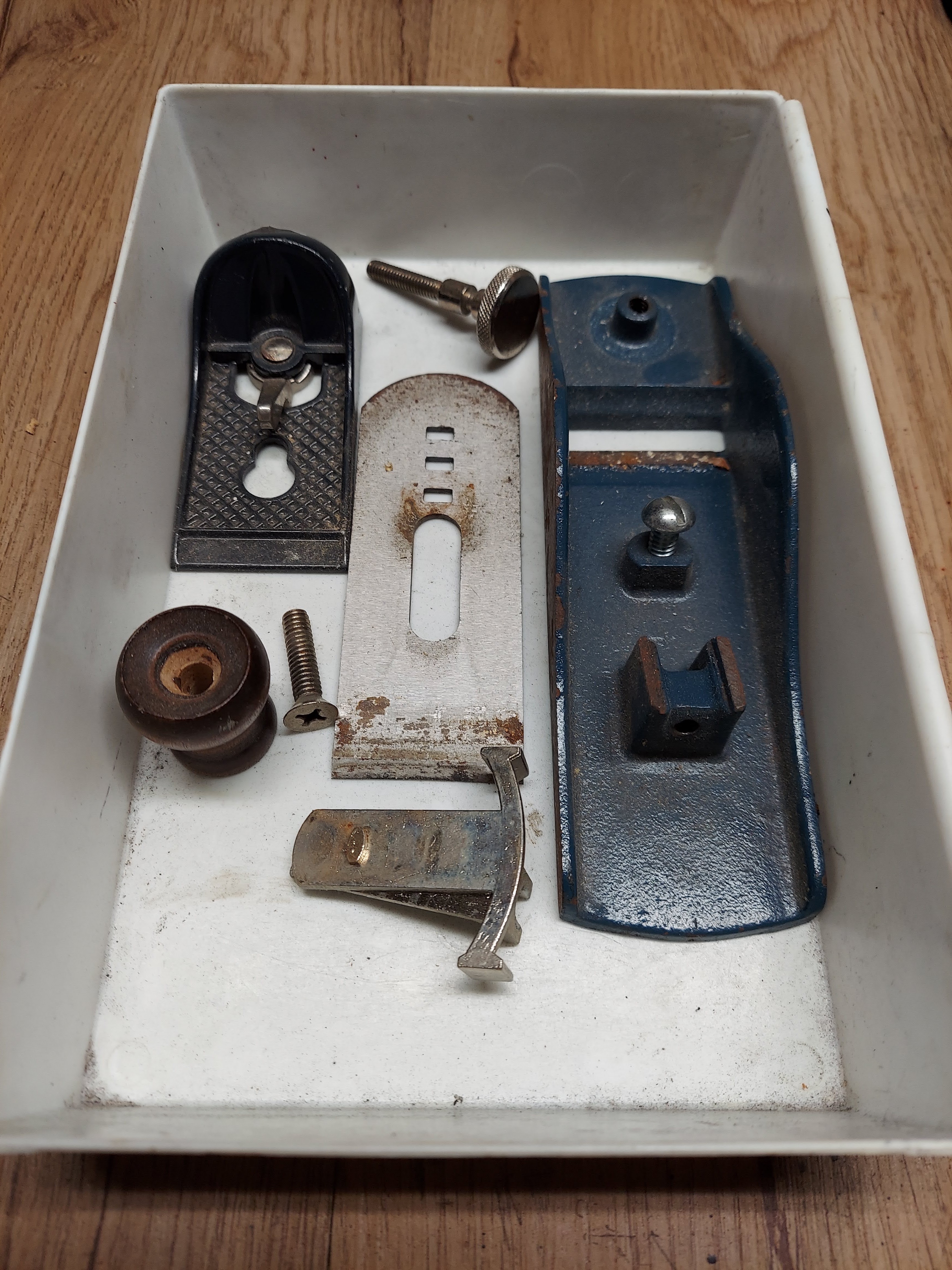
No big repairs needed to be made of the paint or japanning - there were just a minor chips and a little surface rust on the soul and the sides of the plane and on the iron.

After that I just took some sandpaper to the soul and the sides and using my drama I took the paint off the top of the sides of the plane. Because that's where some of the chipping was. Then I just gave the iron quick sharpening and just like that. The plane was restored. The entire project took maybe 20 minutes from start to finish.
Done!
I like restoring the old planes. It's fun and challenging and at times - tedious, but it's also altogether satisfying and enjoyable. This plane didn't need all that work (20 minutes worth was all), but it was still fun, and I like the way the upper edge of the sides turned out, nice and shiny, much like the edges of the more expensive planes!

Some posts about the flora at 173!
2012 - 2020
∙ Spring is in the air! - April 17, 2012
∙ 173 in bloom 2015! - August 24, 2015
∙ 173 - An impressionistic retrospective - July 24, 2016
∙ 173 in bloom - Spring 2020 - May 21, 2020
⎯⎯⎯⎯⎯⎯⎯⎯⎯⎯⎯⎯⎯⎯⎯⎯⎯⎯⎯⎯⎯⎯⎯⎯
You might also like some "Shop Oven" posts!
Natural Habitat
I've had this plane since maybe August or September of '22 and I just hadn't gotten around to giving it a good cleanup until now. In the meantime, this block plane has been living in a little space above the small parts storage rack...

But I wanted to have a spot over the bench, and I recently saw a way to add some light shelving to the peg board over the workbench. I inserted a couple L hooks in the back of a 3/4" board...

And I beveled the top back edge of the board to give it space to tilt the hooks into their holes on the pegboard.

This little shelf became the natural habitat of my little block plane!

Thanks for stopping by and - see ya soon!

I've accumulated enough tools over the years to recognize exactly what you described in the opening. Collections don't always begin with a plan. One day you realize you've somehow acquired half a dozen hand planes because each one offered something just a little different. That felt very familiar.What I appreciated most was your restraint. Too many restorations turn into complete refinishing projects whether the tool needs it or not. This Buck Brothers plane was already in good mechanical condition, so you simply cleaned it, sharpened it, polished the working surfaces, and put it back to work. That's exactly how a user approaches an old tool instead of a museum curator.The ending was my favorite part. Giving the plane its own little shelf above the workbench felt like the perfect conclusion. Good shops evolve the same way old houses do, one thoughtful improvement at a time. That little block plane has gone from sitting forgotten in a toolbox to earning a permanent place within easy reach. Somehow that seems fitting. It wasn't rescued just to sit on a shelf; it was rescued so it could get back to doing what it was built to do. - Alonzo Ignanimous
Frequently Asked Questions
What is a block plane used for?
A block plane is one of the most versatile hand tools in a woodworking shop. It's commonly used for trimming end grain, easing sharp edges, fitting doors and drawers, chamfering corners, cleaning up joinery, and making fine adjustments that would be difficult with power tools. Because it's compact and can be operated with one hand, many woodworkers reach for a block plane more often than any other hand plane.
What's the difference between a block plane and a bench plane?
The primary differences are size, blade angle, and intended use. Block planes are smaller, use a bevel-up blade, and excel at detail work and end grain. Bench planes are larger, use bevel-down blades, and are designed for flattening, smoothing, and straightening larger boards. While both remove wood, they serve very different roles in the workshop.
Should vintage hand planes be restored or simply cleaned?
If the plane is complete and mechanically sound, a careful cleaning is often all that's needed. Removing dirt, sharpening the blade, polishing the sole, and lubricating moving parts can return a vintage plane to excellent working condition while preserving its original finish and character. Full cosmetic restorations are usually reserved for heavily rusted or damaged tools.
Who were Buck Brothers?
Buck Brothers is one of America's oldest edge tool manufacturers, tracing its origins back to the mid-1800s. The company became well known for producing chisels, planes, and other woodworking tools that were widely used by professional tradespeople. Vintage Buck Brothers tools remain popular among collectors because of their solid construction and practical designs.
Why do woodworkers often collect vintage hand planes?
Older hand planes were built during a time when machining tolerances, castings, and steel quality were exceptionally high. Many still outperform inexpensive modern alternatives after little more than cleaning and sharpening. Beyond their usefulness, each plane carries decades of history, making them enjoyable to restore, display, and put back to work in today's shops.
Keywords
Buck Brothers block plane, vintage block plane, block plane restoration, hand plane cleanup, woodworking hand planes, antique woodworking tools, vintage tool restoration, block plane uses, woodworking shop, House 173