

From the Chicago Specialty Mfg Co
An obscure old plumbing wrench gets a new handle, its original red color, and another chance to work beneath the sinks at House 173.

Why a Basin Wrench Matters
I remember struggling mightily to remove the old faucets from the water supply lines on those two early projects. It wasn't that the pipes were so old they were stuck (although that's true too), it's more that I just didn't have many tools back then and had to reach into tight spots with tools too large for the opening. That's where the basin wrench comes in. What's that you ask? From Wikipedia's explanation: A basin wrench consists of a long shaft with a pair of jaws at one end and a handle at the other end. The two jaws form an assembly that automatically closes and grips the fastener. Additionally, the jaw assembly is able to flip over the shaft so the jaws work for both tightening and loosening. The tool is specifically made for tight spaces, particularly in plumbing.

The society which scorns excellence in plumbing as a humble activity and tolerates shoddiness in philosophy because it is an exalted activity will have neither good plumbing nor good philosophy: neither its pipes nor its theories will hold water. - John W. Gardner
Chicago Specialty Manufacturing Co.
I've never heard of Chicago Specialty. Of all the tools I've ever had, and the tools dad has ever had, I've never once heard the name. They're hard to find on the web, but I was able to sort out that they specialized in plumbing tools.
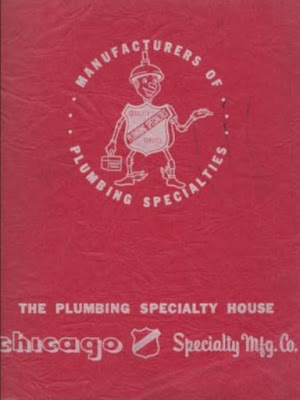
They had facilities in Skokie, Illinois, Sun Valley, California and Brantford, Ontario. The company was sold off (to a food company of all things) and eventually disappeared sometime between 1987 and 1992, after the last of their 1950s trademarks expired.
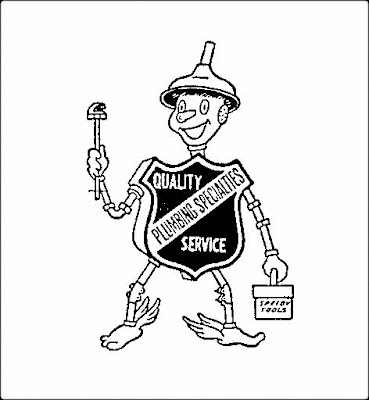
Where Did This Old Wrench Come From?
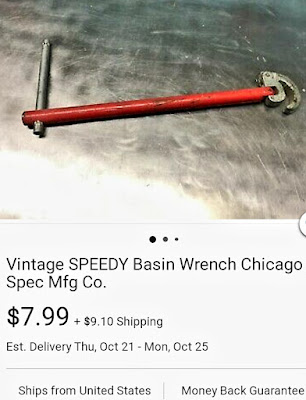
Here's the best part of this tool...it cost me absolutely nothing. Nada. Zero. Zilch. The worst part is..I have no idea where it came from, hopefully it's not because I've been around so long that I've just forgotten. The two theories that bounce around in my head is that I found it in some dark and rainy parking lot (had to add a little drama there, which is certainly erased by explaining that!), or it was inherited from the Moshers. Either way - I didn't buy it! And - check out what I found on the internet...
Cleaning the Basin Wrench and Replacing the Handle
The great thing about that Ebay picture is that it confirmed my suspicion that the tool was originally painted red. And, if you look closely, this picture shows flecks of red still clinging to the wrench...
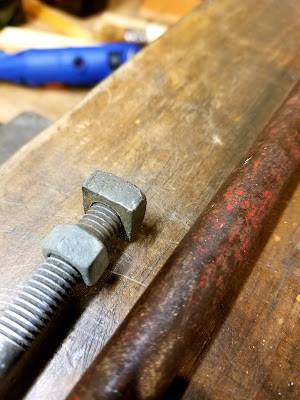
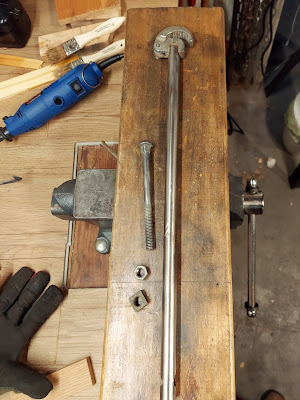
Of course this fits right in with my plan for it - paint it red! Here's the wrench after wire brushing on the bench grinder...
Fabricating a New T-Handle
The only problem with the wrench was the handle was missing. Initially, my plan was to just slap an appropriately sized bolt on the bottom...
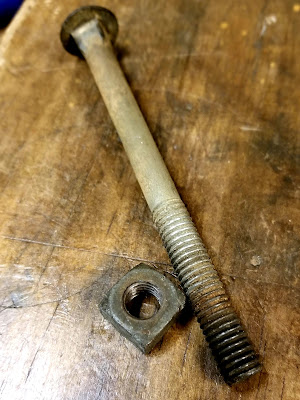
But I thought that solution was just a little too...something...lazy maybe? So I went to Lowes and picked up a steel rod and a couple of rounded nuts and thought that would look nice.
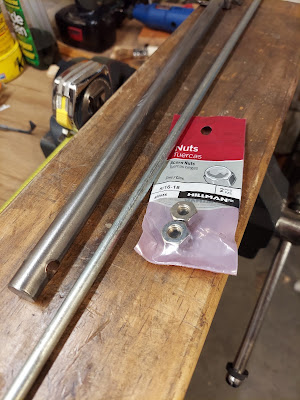
But I wasn't able to cut some threads on the steel. As a matter of fact, I've almost never been successful using my tap and die set. I need to watch a video for some tips on this!
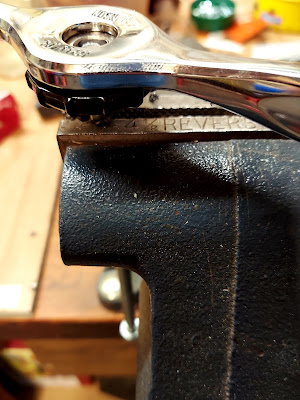
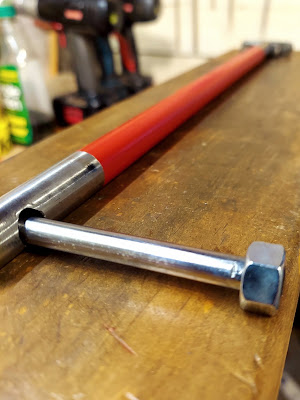
After way more time than it was worth, I finally settled on just using a couple standard nuts and peened over the ends of the handle. I think it'll work just fine.
Returning the Wrench to Its Original Red
That gives you a glimpse of the final product. I think we all knew from the very beginning this wrench would end up red. The fact that it was originally red just gave me permission (as if I needed permission!).

After a little more prep and a quick spray of primer, on went the Krylon Cherry Red. The only thing I did differently than the original was to leave a little steel gleaming at both ends. And, after a couple coats of Carnauba wax (gotta love the smell of this stuff!)...
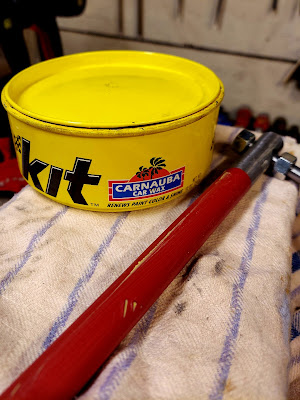
Here she is!

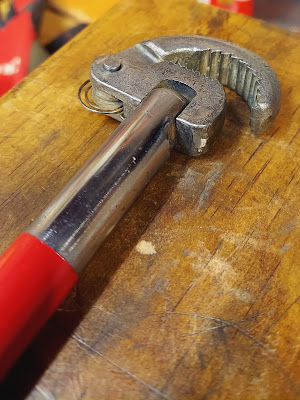
I like the shiny steel at the ends, I think it gives the wrench a little visual interest!
Natural Habitat
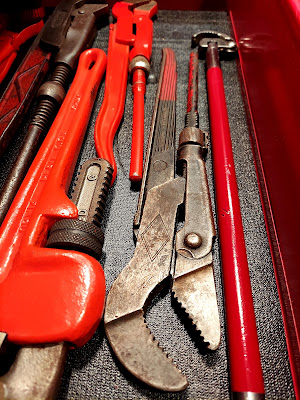
As is my wont, here's a shot of the Speedy Basin Wrench in the wild...
Thanks so much for stopping by - enjoy this fall season, my favorite!

Chicago Specialty?
Now you had me.I have drawers full of old plumbing tools, Ridgid, Walworth, Stillson, Bemis & Call, and I do not remember seeing a Speedy basin wrench from Chicago Specialty. That alone made me study the photographs longer than I probably should admit.
I like that you did not over-polish it. The exposed steel at the working ends makes sense, the red appears faithful to the surviving paint, and the improvised handle looks entirely appropriate for a tool whose job is to disappear beneath a sink and do something unpleasant. The peened rod and nuts may not be factory-correct, but they are honest, functional, and reversible enough that they do not pretend to be anything else.
The company-history section left me wanting more, though perhaps that is part of the appeal. Obscure regional manufacturers are often remembered only through the tools still sitting in basements and old plumbers’ boxes. Sometimes the artifact outlives the records.
One correction from the collector’s bench: do not call this a speedy restoration. You tried threading the handle, changed the plan, peened the ends, primed it, painted it, waxed it, photographed it, and researched the company.
That is only “speedy” by House 173 standards. - The Tool Collector
Frequently Asked Questions
What is a basin wrench, and why is it useful?
A basin wrench is a long-handled plumbing tool designed to reach the mounting nuts and supply-line fittings located behind or underneath a sink. Those connections are often tucked between the basin, cabinet wall, and water pipes, leaving too little room for a standard adjustable wrench or pair of pliers.
The swiveling jaw allows the wrench head to approach a fastener from different angles, while the long shaft lets the user turn it from below the sink. The jaw can also be flipped so it grips in either the tightening or loosening direction. It is a specialized tool, but when space is limited, it can turn an awkward and frustrating job into a manageable one.
How can you restore a rusty vintage basin wrench without affecting its operation?
The first step is to determine whether the rust is merely cosmetic or has damaged the moving parts. On this wrench, the steel was dirty and oxidized, but the jaw and pivoting mechanism still worked. I removed the loose rust and old finish with a wire brush on the bench grinder, then performed additional surface preparation before applying primer and paint.
Any surfaces that grip fasteners, pivot, slide, or bear against another part should remain free of heavy paint buildup. I left polished steel visible at the working ends both for appearance and to avoid coating the areas most likely to experience wear. After painting, I added carnauba wax as a light protective finish.
How do you make a replacement handle for a basin wrench?
A basin wrench normally uses a sliding T-handle through the end of its shaft. My first thought was to install a bolt, which would have worked but looked more improvised than I wanted. I then bought a steel rod and rounded nuts with the intention of threading the ends, but my tap-and-die efforts were unsuccessful.
The final solution was simpler: I passed the steel rod through the shaft, installed standard nuts near the ends, and peened the rod so the parts would remain in place. It may not duplicate the factory construction exactly, but it creates a functional handle, allows leverage from either side, and suits a working tool that was missing an essential component.
Should an old plumbing tool be restored for use or left in its original condition?
That depends on rarity, condition, and intended purpose. A particularly rare or historically significant tool may be more valuable with its original finish intact. This basin wrench, however, was already missing its handle, had extensive surface rust, and was intended to return to occasional use.
The surviving red paint provided evidence of its original appearance, so repainting it red was not simply decorative. The restoration preserved the tool’s recognizable character while making it cleaner, more complete, and pleasant to use. For an ordinary working tool, a sympathetic functional restoration often makes more sense than preserving every patch of rust.
Keywords
vintage basin wrench restoration, Speedy basin wrench, Chicago Specialty Manufacturing tools, plumbing tool restoration, old basin wrench, replacement basin wrench handle, restoring rusty tools, vintage plumbing wrench, Krylon Cherry Red, DIY tool restoration, House 173 tools