

Vintage Tools
How Many Tool Lines Did They Have?
━━━━━━━━━━━━━━━━━━━━
MONTGOMERY WARDS' POWR-KRAFT
BALL PEEN HAMMER, 24 OUNCES
AND MY LONGEST HANDLE YET!
━━━━━━━━━━━━━━━━━━━━
A five-dollar thrift store find, a little Montgomery Ward history, and another vintage tool ready for another lifetime of work.
Much like the linesman pliers (also a Montgomery Wards tool) I posted about last month, I needed another ball peen hammer like I needed another hole in the head. But sometimes, I just can't help myself and here we are with another hammer!
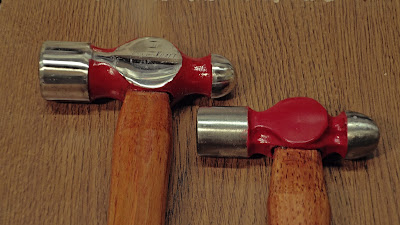
The Five-Dollar Find
It all began with another trip to The Tool Box. I suppose just the fact that I went there weakens my claim for this purchase being unplanned. But it's kinda true in the fact that I had no preconceived notion as to what I was going to get - I just wanted to go! But as my journey through the store progressed, wherein I picked up a few tools, my eye kept going back to the racks of hammers across from the pliers.
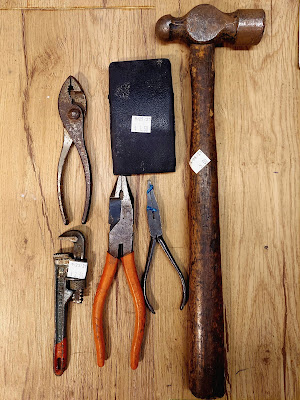
Most of the hammers were in really nice shape, and there was one that I really considered getting but then I saw the winner, and for only $5. Deal done!
What Made This Hammer Different
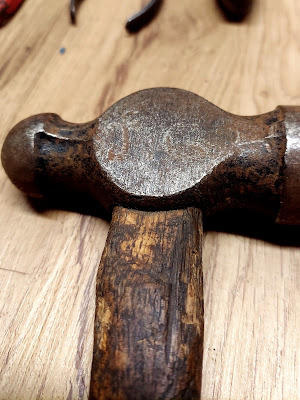
What caught my eye with this hammer was its heft. Obviously I already have a number of hammers, but I didn't have a long-handled, heavier ball peen hammer. How's that for being specific? I guess it's like saying I have 13 cars but I don't have a blue one - any excuse one can find! But aside from its structure, I was also drawn to its condition. The head was in rough shape, with chips around the face, deep scratches and rust all over.
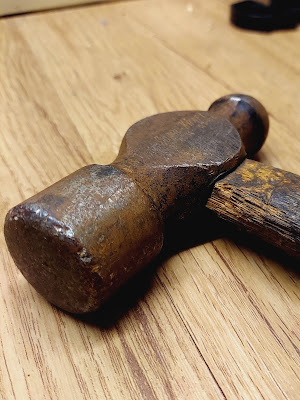
Different hammers really do serve different purposes. A heavier, longer-handled ball peen delivers more striking force with less effort, making it better suited for driving punches, persuading stubborn metal parts, or heavier shop work. My smaller ball peens are still the right choice for delicate tasks, but this one fills a gap I didn't even realize existed until I picked it up.
Who Was Powr-Kraft?
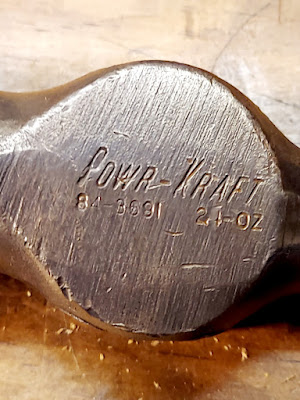
When I first spied the hammer, I saw that it was a Powr-Kraft. The thing is though - I never heard of Powr-Kraft and just thought it was some no-name product, so I didn't think much of it.
I hold in my hand an 1895 Montgomery Ward catalog, and it is a glorious thing -- over six hundred pages -- tens of thousands of items, each illustrated by a woodcut. Six kinds of bicycle-bells range in price from thirty cents to a dollar-ten. A cello costs twelve dollars, and a piano, two hundred. A buggy harness goes for four dollars, and a buggy for sixty. We have to be powerfully struck by the infusion of amenities, functional and frivolous, into our mostly rural America. - John Lienhard, University of Houston
When I got home I looked it up and lo and behold, Powr-Kraft was the brand name used on most of Montgomery Wards woodworking machinery. The trademark "Wards Powr-Kraft" seems to have been first used in 1932. It's funny because just last month I learned that Montgomery Ward tools had three levels of quality:
- Eclipse Quality-Good
- Lakeside Quality-Better
- Master Quality-Best
So where did Powr-Kraft come into play? It's fun learning about some of these behemoths!
Getting to Work
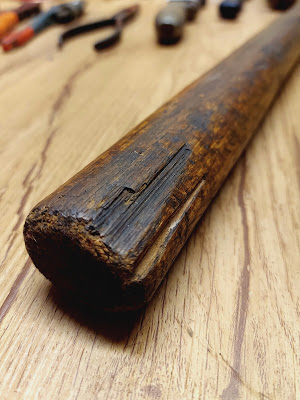
The first step in restoring this hammer was taking it apart. The handle wasn't entirely salvageable, not so much because of the mess it was in, more because it had a bit of a split in it to about halfway down the handle. Taking it apart, while not difficult, certainly took a little doin'!
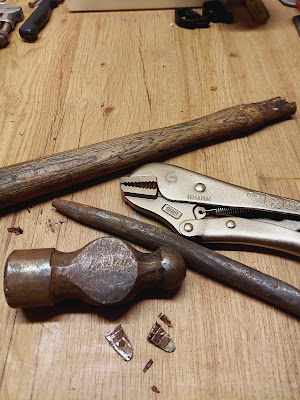
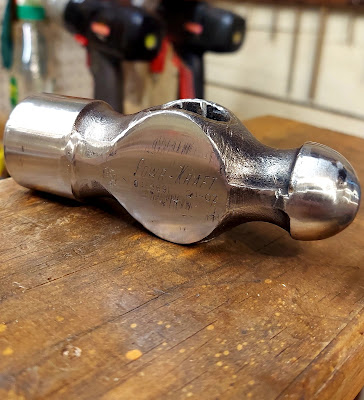
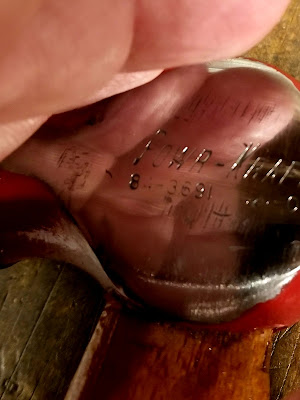
Getting this hammer back in shape wasn't particularly difficult but I had to be careful removing the imperfections with the belt sander because I didn't want to lose the Powr-Kraft etching on the cheek. I know this hammer only has owner's value, and isn't an in-demand collector's item, but I like the thought of this now-defunct retail giant's story being preserved in some small way for the next generation.
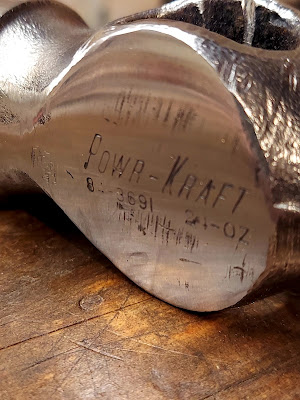
Once the wire wheeling and sanding was done, I ended up with a pretty nice hammer head. For a few minutes I debated leaving it looking all nice and shiny. I really liked this look:

Prepping and Painting
But I had a plan for it since the moment I saw the hammer hanging on the wall at The Tool Box. Much like one of the other ball peens I did recently, I wanted this one to have a touch of the now-signature color for 173. So, first I had to prime the hammer head, and I thought I'd try using some car wax on areas I didn't want painted instead of taping (clearly I heard of this somewhere):
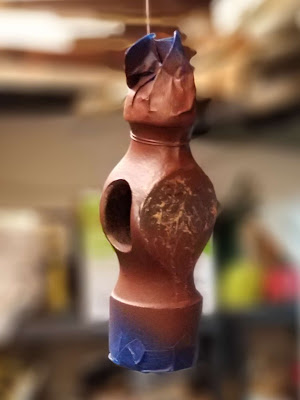
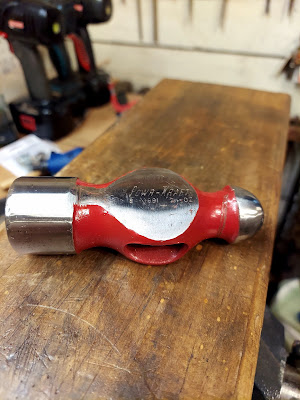
It worked okay, but it left the edges a little ragged instead of sharp and crisp. I think I'm sticking with taping in the future. After the primer dried, it was just a matter of spraying on the ol' Rustoleum Cherry Red, and just like that - things were taking shape.
Fitting a New Handle
Like I mentioned earlier, the old handle was in pretty bad shape so it had to be replaced. I have a couple handles in a drawer, but the hammer head being 24 ounces the handle needed to be a bit more substantial and longer in order have good proportion and balance. So I picked one up from the local Tractor store and away we went! Using the eye end of the original handle, I marked out the removal areas...
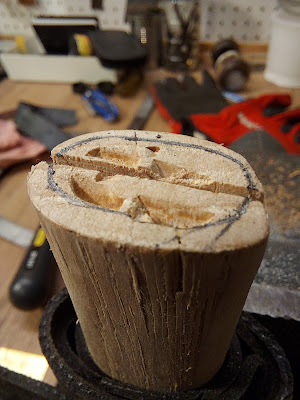
Then in went both the wood and metal wedges...
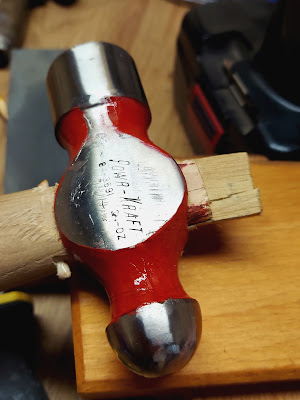
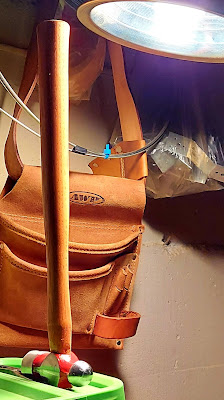
With the head secure, I went about staining the handle with a couple coats of Minwax Gunstock stain, and put it in my version of the Easy Bake Oven:
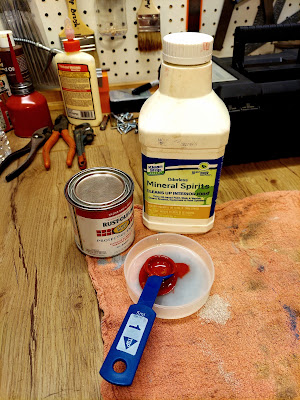
Then, because I really liked the outcome of my "fancy-handled" ball peen hammer, I mixed up a little of my enamel paint/mineral spirits stain...
And gussied up the new handle...
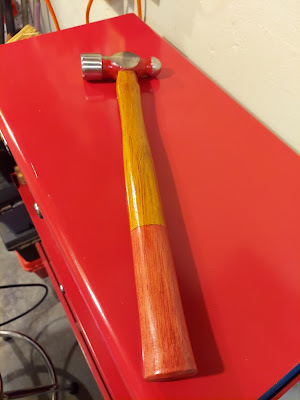
Ready for Another Lifetime
Before we wrap up - let's remember where we started...
And just like that, this little hammer restoration was complete! It isn't perfect, then - neither am I. The cheeks have a bit of a mirror finish to them, but you can still see some of the scratches are still there. Like I said earlier, I took the steel down as far as I was willing to because I wanted to keep the writing...
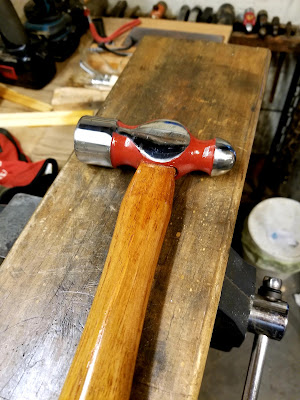
I touched up the paint a bit, and used the Flitz metal polish to shine 'er up...
Here's the new hammer next to the original one I did in September...
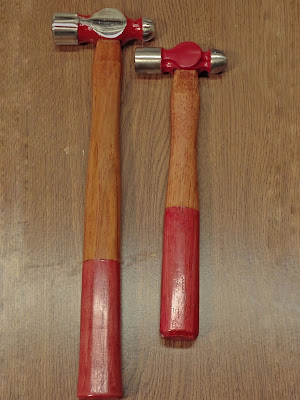
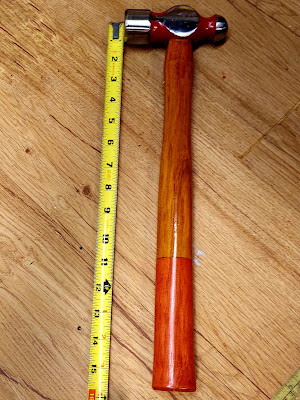
With that picture I think you can see just how much larger the Powr-Kraft hammer is. Here's the tale of the tape:
Into the Wild
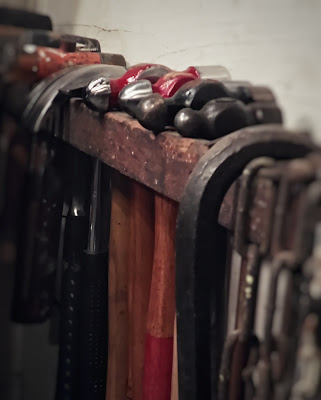
And so, before we sign off, let's take a peak of the newly restored Montgomery Wards Powr-Kraft 24-ounce ball peen hammer in its natural habitat!
Thanks for checking in!

You know what made me smile?It wasn't the finished hammer.It was the sentence where you admitted your eye kept drifting back to the hammer rack.Anyone who's ever wandered a flea market, antique store, or Habitat ReStore knows exactly how that feels. You tell yourself you're "just looking," and meanwhile one object has already chosen you. You're just taking the scenic route before admitting it.I also appreciated that you let yourself change your mind during the restoration. First you liked the polished steel. Then you remembered your original vision. Then the wax masking experiment wasn't quite what you hoped, so you decided tape still wins. That's real shop work. Rarely does everything go exactly according to plan.My favorite part, though, was your respect for the Powr-Kraft name. Most people would've sanded until every scratch disappeared. You stopped before the lettering did. That told me this wasn't about making an old hammer look new, it was about making sure another piece of American tool history survives long enough for someone else to wonder, years from now, "Powr-Kraft...what was that?" That's exactly the kind of curiosity that keeps these old tools alive. - A Flea Market Regular
Frequently Asked Questions
What is a ball peen hammer used for?
A ball peen hammer is designed primarily for metalworking. The flat face is used for striking punches, chisels, and shaping metal, while the rounded "ball" end is useful for peening rivets, forming metal, and creating controlled blows without sharp edges. They're also common in automotive, mechanical, and general workshop applications.
Who made Powr-Kraft tools?
Powr-Kraft was Montgomery Ward's primary brand for power tools and many shop tools beginning in the early 1930s. Like other major retailers of the era, Montgomery Ward contracted with established manufacturers to produce tools under its house brands. Although the Powr-Kraft name disappeared decades ago, many of the tools remain well-built and fully usable today.
Why replace an old hammer handle instead of keeping the original?
If the original handle is cracked or weakened, replacing it is often the safest choice. A loose or damaged handle can allow the head to separate during use. Installing a properly fitted hardwood handle restores both safety and functionality while preserving the original hammer head.
Should vintage tools always be repainted?
Not necessarily. Some restorers prefer preserving original finishes and patina, while others repaint tools that were originally painted or whose finishes have deteriorated beyond preservation. The decision depends on the intended use, the rarity of the tool, and the restorer's personal philosophy.
Why are vintage Montgomery Ward tools still collected?
Many Montgomery Ward tools were manufactured by respected American tool companies and sold under house brands like Powr-Kraft, Lakeside, Eclipse, and Master Quality. Their solid construction, historical significance, and connection to one of America's great mail-order retailers make them appealing to both users and collectors.
Keywords
Powr-Kraft hammer, Montgomery Ward tools, ball peen hammer restoration, vintage hammer, hammer rehandle, vintage tool restoration, Powr-Kraft tools, Montgomery Ward history, antique hand tools, House 173