


The Ultimate Scrap Wood Workbench (for me)

Every Workshop Needs a Workbench
I follow quite a few Youtubers who post about their woodworking, rehab and DIY projects, and every so often they post about building their incredible woodworking or shop workbench. The variety of bench styles tremendous!
Some are beautiful.

Some complicated.
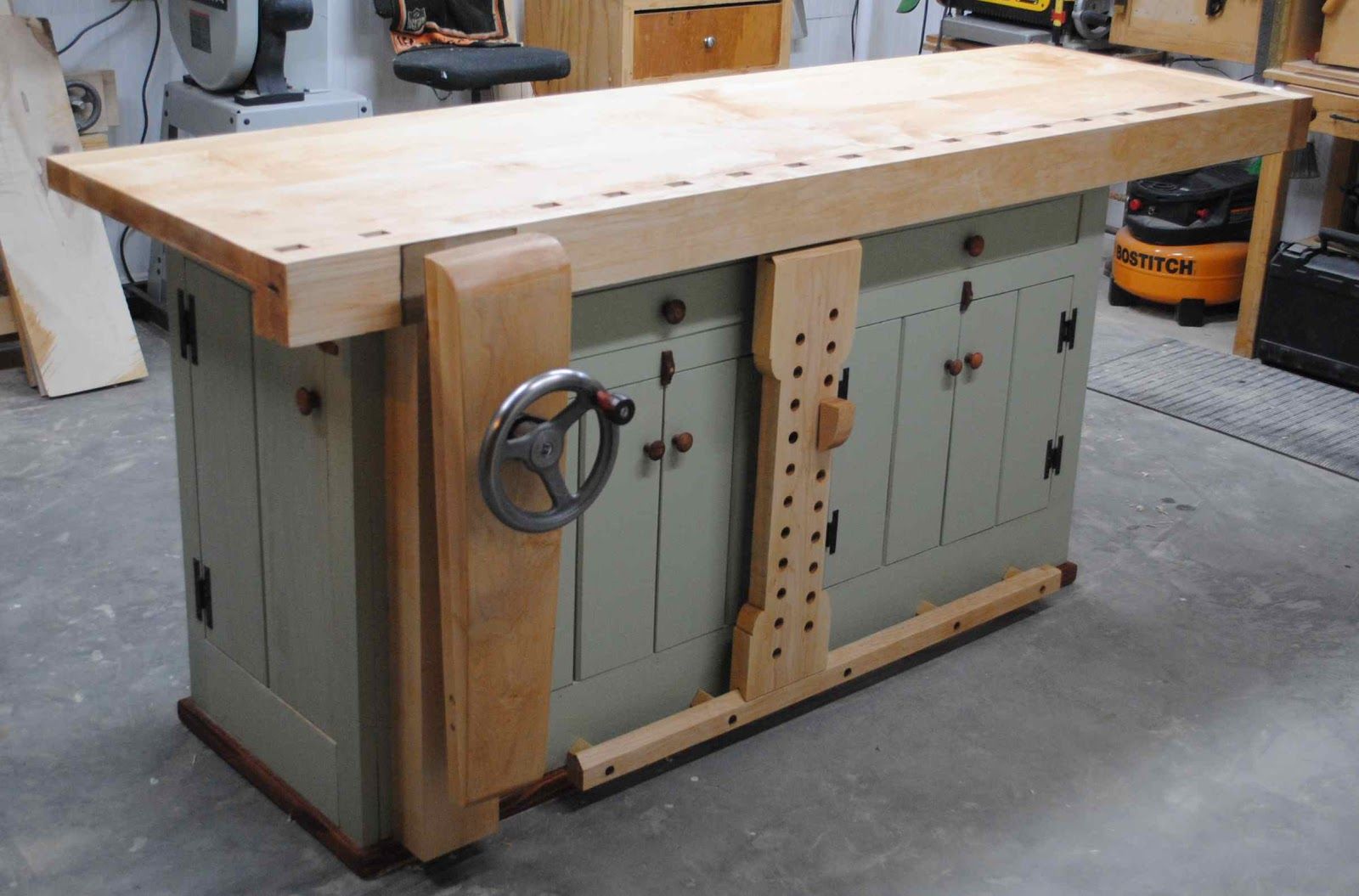
Some are absolute behemoths that weigh more than my first car.

And some are simple and utilitarian.
No matter the style or the price tag, though, every great workbench shares one thing in common, it perfectly suits the person who built it. That's really the whole point. A workbench isn't meant to impress visitors; it's meant to make work easier, safer, and more enjoyable.

Built from What We Had
It's of the very simplest of construction, but this simple bench has faithfully served 173 for some 20 years now. It's not huge by any means, but measures 78" long by 27" deep and 34" tall. I've thought about building a new "fancier" bench, but I have a bit of a sentimental attachment to this ol' beast, here's why...

A Bench Built by Family
Back in 1999, relatives from Germany came for a visit to help me put in new basement windows and a new basement floor. After two gruelling weeks, we built this "temporary" bench with old 2x4s and 2x8s that were left by the Moshers when we bought 173.
That temporary bench never left.
The total cost to build it?
Exactly $0.
So the 173 workbench was:
1. Made at 173.
2. Made by family.
3. Built from old-growth lumber that had been at 173 longer than we had.
4. Built entirely from scrap wood.
Put all those together, and you've got the real reason I've never seriously considered replacing it. Every ding, saw cut, paint stain, and glue drip tells part of the story of this house and the projects we've tackled over the years.

Now, I did pick up another bench for the main part of the basement...

That bench holds the drill press and stores some of the benchtop tools like the router, scrollsaw, etc, and gets a lot of use too. But my workshop bench is still the heart of the shop.
The Workshop Evolves
Here's what she looked like when I was fixing up the basement a bit...

What a mess that was! You can barely make out the bench. After the basement was finished, including the workshop,

A New Work Surface
I started making alterations here and there to the bench. The benchtop is made up of three 2x8s and I used to keep an old hallway runner on top - I'm not sure why. But with the kitchen re-do in 2017, I put in Luxury Vinyl Plank flooring and had a bunch of small plank cutoffs leftover, so I thought heck - why not give the bench a strong, durable top over the 2x8s?

It's been on the bench for over a year, and this stuff has held up nicely, and makes it super easy to clean!
Adding Storage
Then, a couple months ago, noticing I was running out of product and tool storage space, I decided to add some drawers...

Of course they're made from scrap pine and MDF boards, I just can't help myself! The drawer fronts came from the old dining room bookshelves removed when we re-did the dining room in '17 - '18.

And I kept the drawer-slide mechanism uber simple!

Working Around the Vise
But for the large drawer on the right, there was an obstacle...

The vise has been in that spot pretty much since day one, and I really didn't want to move it because it seems to be the perfect spot for it, so I just worked around it - literally...

That's important because I built the drawers a little short so they could be recessed out of the way in the event (which is actually not a rarity for me) that I need to clamp something to the bench...

Built to Be Used
The only other feature to point out is that this workbench is rock solid. No matter what I do, this thing doesn't move! Of course that may be due in large part to the fact that it's secured to the foundation...

After all these years, I've come to realize that a workbench doesn't have to be beautiful to be successful. It doesn't have to be made from maple, feature elaborate joinery, or weigh 500 pounds.

It simply has to be dependable.

Woodworking matters. It's more than a pastime or hobby—being a woodworker means that you know the satisfaction and pride that comes from using your hands and mind to build beautiful, functional objects, and that you're as interested in the process as the outcome. Amid the speed and chaos of the modern world, woodworking gives us a place where we can slow down, pay attention, and take the time to do things right. - Aimé Ontario Fraser

More Than Just a Workbench
A good workbench quietly becomes part of every project you build. It catches glue drips, takes accidental saw cuts, holds boards while you wrestle with them, and never complains when you ask it to do one more job. Over time, it stops being just another shop fixture and starts becoming part of the story behind everything you've made.

And that's exactly what this bench has become for me.
It's no work of art.
It's not complicated.
In fact, it's probably one of the ugly ducklings of the woodworking world.
But it works.
It's solid.
It's original.
It's sentimental in a way that's hard to explain.
And I wouldn't trade it for anything.

Hey, thanks for stopping by. See ya' next time!
George
Frequently Asked Questions
What makes a good woodworking workbench?
A good workbench doesn't have to be elaborate or expensive. The most important qualities are stability, a comfortable working height, sufficient work surface, and the ability to securely hold projects while you work. Whether it's built from hardwood or scrap lumber, a bench that fits your style of woodworking will almost always outperform one built simply to impress.
Can you build a strong workbench from scrap wood?
Absolutely. Many excellent workbenches have been built from reclaimed framing lumber, construction offcuts, or salvaged materials. With solid joinery and thoughtful design, scrap wood can produce a bench that's just as sturdy and functional as one made from premium hardwoods.
What is the ideal height for a workbench?
Workbench height depends on the type of work being performed and the user's height. Benches used primarily for hand-planing are often slightly lower, while benches intended for detailed assembly or finishing may be taller. The best height is one that allows comfortable work without constant bending or reaching.
Why should a workbench be heavy?
Weight is one of a workbench's greatest advantages. A heavier bench resists movement while sawing, planing, chiseling, or clamping workpieces. Many woodworkers intentionally build their benches with thick tops or anchor them to a wall or floor to eliminate movement during demanding tasks.
Is it worth adding drawers to a workbench?
For many home workshops, yes. Built-in drawers make efficient use of otherwise unused space beneath the bench while keeping frequently used tools and supplies close at hand. Careful placement, however, is important so the drawers don't interfere with clamps or larger projects.
What is the best material for a workbench top?
Traditional hardwoods such as maple and beech are popular because they're durable and resist wear. However, construction lumber, plywood, laminated tops, or even durable flooring materials can all provide excellent work surfaces when properly installed. The best surface is one that matches the work being done and is easy to maintain.
Should a workbench be permanently attached to the wall?
Not necessarily, but anchoring a workbench to a wall can dramatically increase its rigidity. In smaller workshops where mobility isn't important, securing the bench helps eliminate movement during heavy woodworking or metalworking tasks.
How long should a homemade workbench last?
A well-built workbench can easily serve for decades. Unlike many shop fixtures, workbenches often evolve over time with added storage, new vises, replacement tops, or other improvements. Rather than wearing out, they tend to become better suited to their owner's needs with each modification.
Why do many woodworkers keep the same workbench for years?
Because a workbench gradually becomes part of the way they work. Every modification reflects lessons learned, every scratch recalls a completed project, and every improvement makes the bench more personal. Over time, replacing it often feels less appealing than simply continuing to improve it.
Does a workbench have to be beautiful?
Not at all. While finely crafted benches can be works of art, many of the best workbenches are simple, well-used, and covered with the marks of years spent building things. Their beauty comes from usefulness rather than appearance.
Keywords
scrap wood workbench, homemade workbench, DIY workbench, woodworking workbench, workshop bench, garage workbench, building a workbench, reclaimed wood workbench, workbench storage drawers, woodworking shop, DIY workshop ideas, vintage workshop, woodworking bench plans, bench vise workbench, House 173